A complete research-paper list from INSPIRE, with expanded research highlights, selected figures, tables and key equations, with abstracts and downloadable citations.
How do the symmetries of a black-hole horizon become symmetries of a fluid action? We answer this explicitly in JT gravity and in the BTZ geometry, where the derivative dependence can be kept exact.
Constructs hydrodynamic actions for small perturbations of thermal states dual to JT and AdS₃ black holes. Unlike a usual gradient expansion, the calculation keeps every order in derivatives; the simplification comes from the highly constrained stress-tensor dynamics of these theories.
Identifies the fluid fields as relative diffeomorphisms between the asymptotic boundary and the horizon. Evaluating the gravitational action partially on shell leaves these fields dynamical, and their equations of motion impose the remaining Einstein constraints.
Motivates the horizon boundary conditions through a well-defined variational principle. With the main choice of mixed conditions, diffeomorphisms preserving the horizon data induce explicit redundancies of the hydrodynamic fields.
Recovers the quadratic Lorentzian Schwarzian action in source-free JT gravity and derives a corresponding BTZ action. Both can be rewritten in compact diffeomorphism- and Weyl-covariant forms, making their relation to the field-theory Ward identities clearer.
Shows explicitly that the constant and exponential horizon modes are zero modes of the action and leave the physical stress tensor unchanged. This gives a geometric realisation of symmetries previously proposed in effective descriptions of maximal quantum chaos.
Derives alternative actions using Dirichlet data at a stretched horizon. These have different horizon symmetries but reproduce the same stress-tensor two-point functions at generic frequencies, showing why the choice of horizon data matters even when the measured response agrees.
The constant, decaying and growing shifts preserve the chosen horizon data and leave the stress tensor unchanged. Here r₀ = 2πT. The growing term is a zero mode of the description; it is not an instability of the energy density. Cropped from the original paper.
Scope. Exact in derivatives within the small-amplitude expansion. The exponential modes are redundancies of the hydrodynamic description, not exponentially growing energy-density perturbations. A fully nonlinear construction and the higher-dimensional chaos mechanism remain open.
Read abstract
We demonstrate how horizon symmetries of AdS black holes are realised in the hydrodynamic actions for the dynamics of the dual stress tensor. A recent approach for obtaining such actions involves a choice of horizon boundary conditions, and we show that diffeomorphisms that preserve these give rise to symmetries of the corresponding hydrodynamic action. We obtain explicit hydrodynamic actions for small amplitude perturbations of black holes in JT and AdS$_3$ gravity using this approach and demonstrate explicitly the existence of these symmetries. For a natural choice of boundary conditions, the resulting actions manifestly realise gauge symmetries previously proposed for effective theories of maximal chaos.
Rewrites short-distance CFT data in geometric language and uses locality to test correlation functions on curved backgrounds.
Organises the OPE of scalar primary fields using geodesic distance, the tangent to the connecting geodesic, and curvature tensors at one insertion point. This gives a coordinate-independent way to separate geometry from theory-dependent coefficients.
Constructs the complete scalar-channel descendant tower on conformally flat Euclidean backgrounds in dimensions D ≥ 3. A sequence of Weyl and covariant-derivative maps turns the known flat-space OPE into an algorithm valid to arbitrary order.
Relates the derivative map to conformal tractor geometry and the Thomas operator, explaining why curvature-dressed derivatives arise naturally in the descendant expansion.
Derives the short-distance expansion of the ambient geodesic invariant, including Schouten curvature and its derivative, and checks its symmetry under exchanging the endpoints.
Uses free-field Hadamard expansions as independent checks in three and four dimensions, distinguishing local singular terms from smooth, state-dependent contributions.
Tests a pairwise ambient contribution to a three-point function against a local covariant OPE. The mismatch fixes short-distance terms of a correction involving all three insertions: Cotton curvature in three dimensions, and Weyl curvature and its derivatives in higher dimensions.
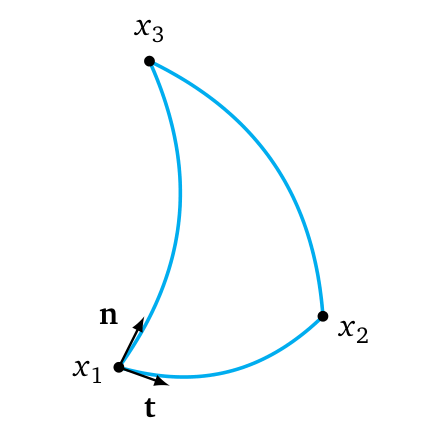
Develops a covariant geodesic-triangle expansion to compare the two nearby insertions with the third point. This is the geometric calculation behind the curved-space illustration on this website.
The short-distance limit brings x₂ towards x₁ while keeping x₃ farther away. Both geodesic separations are small compared with the local curvature radius; their unequal sizes organise the OPE expansion. Cropped from Figure 4 of Das, Konechny and Umasankar.
Scope. The all-orders construction concerns scalar-channel descendants on conformally flat backgrounds. On general backgrounds, the required trilocal correction is determined locally through the retained orders in separation, curvature and curvature derivatives; a full global three-point function is left open.
Read abstract
In this paper we consider some general aspects of Euclidean conformal field theories on curved spaces of dimension $D\ge 3$. We first look at the OPE of scalar primary fields on conformally flat spaces. Extending the results of [see references in the paper], we give a general construction of the descendants' contributions to the OPE in the scalar channel. We then discuss CFTs on non-conformally flat spaces in the ambient space formalism. We investigate the short-distance behaviour of three-point functions on such spaces using the general ansatz proposed by Parisini, Skenderis, and Withers [see references in the paper]. We find that some additional corrections need to be added to the ansatz to ensure the existence of a local covariant OPE.
A differential map turns the Wronskian index from a label for separate bootstrap problems into a way of organising related families of character functions.
Introduces the weight-preserving operator Θ = η⁻⁴D, combining the Ramanujan–Serre derivative with the Dedekind eta-function. Its action changes the modular multiplier in a controlled way.
Constructs an invertible relation, up to normalisation and within the stated class, between the rank-two ℓ = 0 and ℓ = 2 equations. This makes two apparently different character problems part of the same construction.
Combines repeated Θ operations with modular functions to reach the non-rigid sectors with movable poles. At ℓ = 6, the construction introduces the one additional free parameter expected from the pole analysis.
Extends the construction across the allowed rank-two and rank-three Wronskian sectors. In rank three, the remaining classification problem is reduced to understanding the ℓ = 0 quasi-characters.
Shows how bounded-denominator integrality is retained by the construction, while explicitly separating this arithmetic property from positivity of the Fourier coefficients.
Uses the map and the earlier ℓ = 0 estimates to establish sign and growth properties for rank-two ℓ = 2 quasi-characters that had previously been conjectural.
Compares the construction with Hecke and Bantay–Gannon methods, clarifying that maps can reach the same Wronskian sector while producing different modular representations.
For rank two, the map sends an ℓ = 0 solution to an ℓ = 2 solution. The eta-factor cancels the derivative’s increase in modular weight but changes its multiplier system. Positivity is not generally preserved.
Scope. The reduction is made within the non-logarithmic, irreducible class treated in the paper. Positivity is not generally preserved, so mapped quasi-characters still need admissibility checks and CFT realization is a separate question.
Read abstract
Characters of rational conformal field theories solve modular linear differential equations labelled by their order and the Wronskian index $\ell$. Direct classification of admissible solutions by solving MLDEs becomes increasingly difficult at higher $\ell$-- where movable poles and accessory parameters appear. In this work we introduce differential operators that relate higher-$\ell$ solutions to lower-$\ell$ ones while preserving modular covariance and integrality of the \(q\)-series. In rank two, this generates all allowed Wronskian sectors from the Mathur--Mukhi--Sen equation. In rank three and higher, it reduces the construction of higher-$\ell$ quasi-characters to simpler equations with lower $\ell$. This gives an efficient new route for organising candidate RCFT characters, and more generally quasi-characters, across the Wronskian tower. As an application, we apply our construction to prove a previously conjectured property on the signs of $\ell=2$ quasi-characters in rank 2.
Develops a gravitational prescription for an action that describes both viscous relaxation and thermal fluctuations of the stress tensor in a holographic plasma.
Builds a Schwinger–Keldysh action from linearised metric perturbations of an AdS₄ Schwarzschild black brane. The doubled gravitational contour provides the two copies of fields needed for dissipative real-time dynamics.
Identifies the hydrodynamic variables geometrically: they are relative diffeomorphisms between the black-hole horizon and the two asymptotic boundaries of the contour, rather than extra degrees of freedom introduced by hand.
Solves the transverse and longitudinal perturbation problems partially on shell. The gravitational action is computed to quadratic order in fluctuations and first order in derivatives, retaining the fluid fields that enforce energy and momentum conservation.
Checks that integrating out those fields reproduces the known low-energy stress-tensor Green functions. The symmetric and retarded correlators satisfy the fluctuation–dissipation relation to the order studied, linking the noise terms to viscous response.
Uses the near-horizon variational principle to motivate boundary conditions for the metric. It then identifies residual horizon diffeomorphisms and directly verifies the associated time-independent shifts in the constitutive relations.
Compares an alternative choice of horizon conditions and tracks how this changes the exponential symmetry modes. The comparison exposes why a proposed connection with quantum chaos cannot be settled using only a finite derivative expansion.
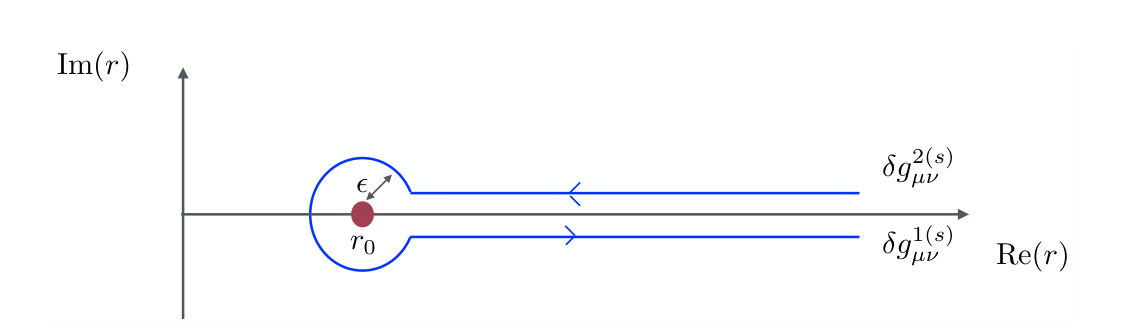
The two radial branches carry the two boundary sources of the Schwinger–Keldysh description and are joined around the horizon. This contour is the geometric starting point for obtaining dissipation and fluctuations in a single effective action. Cropped from the original paper.
Scope. Quadratic in fluctuation amplitudes and first order in derivatives. The exponential horizon transformations are identified, but their status as symmetries of the complete action requires information at all derivative orders; this paper does not claim that proof.
Read abstract
We give a prescription to compute a dissipative action describing the large-scale thermal stress tensor dynamics of a holographic quantum field theory dual to AdS$_4$ gravity, in the context of the Schwinger-Keldysh formalism. Our prescription is valid to quadratic order in perturbations about the thermal equilibrium state. The hydrodynamical degrees of freedom of this action are realised in gravity as relative diffeomorphisms between the black hole horizon and the two asymptotic boundaries of the Crossley-Glorioso-Liu contour. We explicitly compute the action to first order in derivatives, and confirm it correctly reproduces the known hydrodynamic Green's functions. Our prescription requires a choice of horizon boundary conditions for the metric. We study the horizon symmetries that preserve these, and their relation to conjectured hydrodynamic symmetries responsible for many-body quantum chaos.
Uses commuting CFT factors to make symmetry-line information visible inside a meromorphic parent theory.
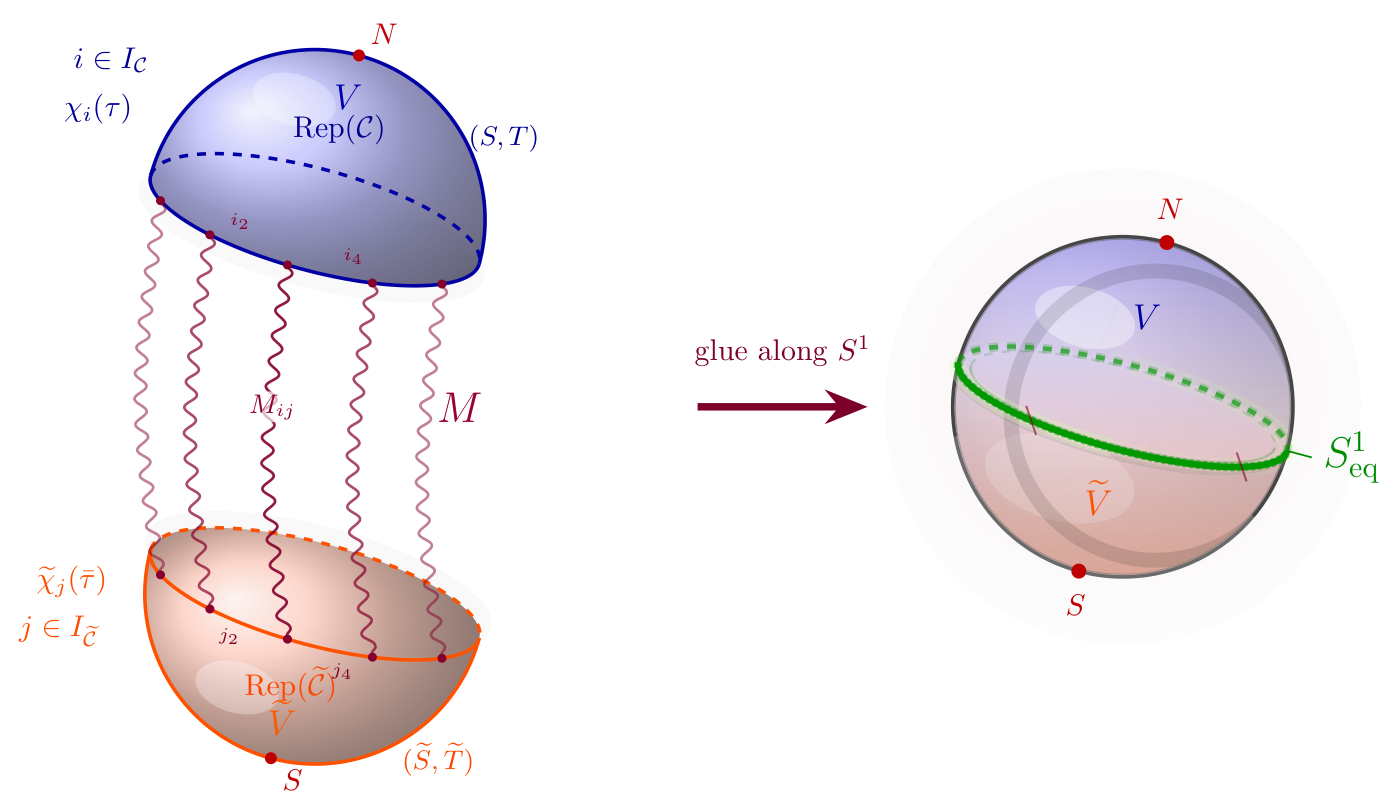
Introduces an equatorial-projection description of commutant pairs: a matrix pairs the character sectors of two commuting chiral theories, turning their coupling into explicit algebraic data.
Uses topological defect insertions to refine information that is hidden in the ordinary vacuum character of a meromorphic CFT. Different decompositions of the same parent can expose different defect observables.
Tracks the modular transformation of an inserted line by conjugation, relating diagonal Verlinde-line actions to fusion actions in a crossed channel.
Distinguishes two mechanisms for invertible defects: simple-current lines acting through modular S-matrix eigenvalues, and anyon permutations associated with braided autoequivalences.
Reinterprets character replacement rules as transformations of commutant gluing data. The modular-intertwiner conditions provide a way to test when the resulting coupling is modular invariant.
Studies E₈,₁ commutant pairs beyond the two-character setting, including three-character and tensor-product examples, supported by branching rules and explicit character calculations.
Separates genuine partition functions from more general defect or interface amplitudes: modular covariance alone does not make an insertion the partition function of a new full CFT.
The gluing matrix M records which sectors of the two chiral theories are paired. A defect acts on this pairing, and modular transformations constrain the resulting amplitude. Cropped from Figure 1 of Umasankar and Das.
Scope. The explicit analysis centres on selected commutant pairs inside E₈,₁. The paper proposes a framework and studies examples; its higher-central-charge discussion is an outlook rather than a complete classification of meromorphic theories or defects.
Read abstract
We develop a defect-theoretic refinement of meromorphic 2d CFTs in which the ordinary torus partition function -- often just the vacuum character -- does not reveal how states organize under symmetry lines. Our central proposal is an equatorial projection framework: from a commutant decomposition into commuting rational chiral algebras with categories $\mathcal{C}$ and $\widetilde{\mathcal{C}}$, we encode genus-one couplings by a non-negative integer matrix $M$ pairing characters and satisfying modular intertwiner relations. Invertible topological defect lines act directly on this gluing data (Verlinde lines diagonally via $S$-matrix eigenvalues, and anyon-permuting lines by braided-autoequivalence permutations), making modular covariance of defect amplitudes automatic and sharply distinguishing insertions that yield genuine modular invariants from those defining consistent non-holomorphic interfaces. We further show that the replacement rules of [see references in the paper] arise as equatorial projections of defect actions, and we extend these constructions beyond two-character examples by systematically treating three-character commutant pairs in the $E_{8,1}$ theory. The unique $c=8$ meromorphic CFT $E_{8,1}$ serves as a universal testbed, producing new defect partition functions and clarifying the roles of $\mathrm{Pic}(\mathcal{C})$ and $\mathrm{Aut}^{\mathrm{br}}(\mathcal{C})$. Finally, we outline extensions to higher central charges (e.g. $c=32,40$), yielding modular-invariant non-meromorphic theories beyond the $c=24$ Schellekens landscape [see references in the paper] as defect/interface descendants of meromorphic parents.
Quasi-characters can have negative coefficients even though they obey modular consistency. This work determines where those signs occur and how rapidly the coefficients grow.
Proves the characteristic pattern of alternating signs followed by sign stabilisation for rank-two quasi-characters at Wronskian index ℓ = 0, across the families studied in the paper.
Gives two complementary approaches: a controlled limit in which the central charge and Fourier level grow together, and an exact induction based on the MLDE coefficient recursions.
Obtains estimates near the crossover level n ≈ 2|M| ≈ |c|/12, with c = 24M + j. This is a different limit from the usual Cardy or Rademacher asymptotics at fixed central charge.
Establishes growth bounds useful for comparing neighbouring coefficients and for controlling the negative terms that must be cancelled in a linear combination of quasi-characters.
Explains how the sign information feeds into the holomorphic modular bootstrap: admissible character vectors arise from combinations whose Fourier coefficients are non-negative integers.
Identifies an intriguing correspondence between the sign-stabilisation scale and the light-to-medium state boundary familiar from large-central-charge CFT. Its physical interpretation is left as a question, not a claimed holographic dual.
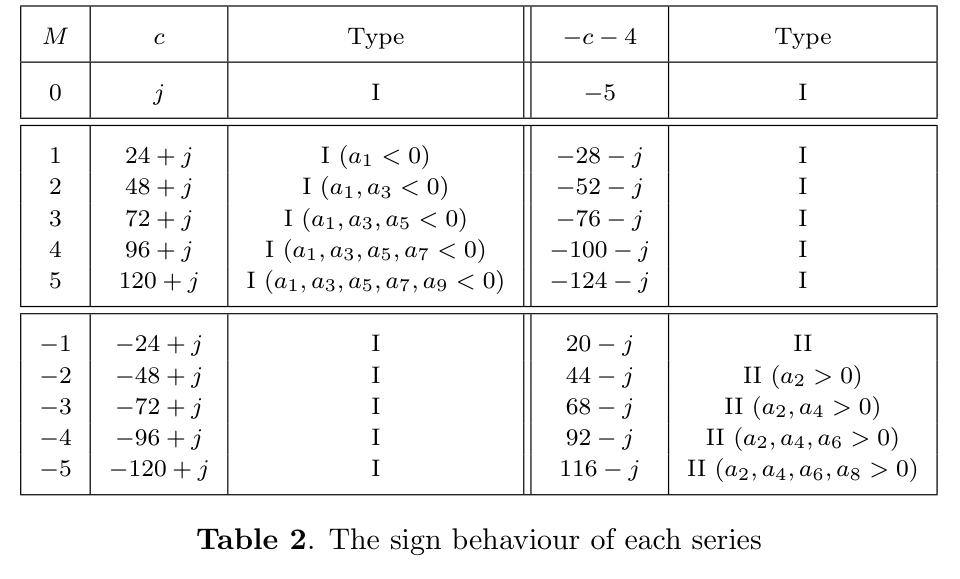
Table 2 records the sign pattern as the family parameter M changes. Type I and II distinguish the eventual sign behaviour; the entries in parentheses identify the exceptional early coefficients. The pattern, rather than a finite numerical check alone, is the object of the proofs.
Scope. The paper studies rank-two, ℓ = 0 quasi-characters. An admissible spectrum is a candidate for an RCFT; it does not by itself establish a complete conformal field theory.
Read abstract
Rational conformal field theories in 2d have partition functions built from holomorphic characters, whose classification can be addressed via the holomorphic modular bootstrap. This is facilitated by a special basis of ``quasi-characters'' that has been completely classified for rank-2. Suitably combining these to form admissible characters with non-negative integral coefficients $a_n$ depends crucially on the signs and growth of the quasi-character coefficients. We use Frobenius recursion relations for Modular Linear Differential Equations to estimate the growth with $c$ of these coefficients in the region $n\sim\frac{c}{12}$ that is inaccessible to Cardy asymptotics, and to prove rigorously that they have alternating signs that stabilise to a fixed sign at this order. This provides a practical path to obtain candidate RCFT partition functions at arbitrary Wronskian index.
Extends symmetry-resolved entanglement from untwisted sectors to defect-twisted and anyonic sectors.
Organises the Hilbert spaces obtained by inserting topological defect lines, allowing entanglement to be studied in sectors that are absent from the ordinary untwisted decomposition.
Uses the tube-algebra and symmetry-TFT viewpoint to identify generalized charges with bulk anyons of the associated three-dimensional topological theory.
Constructs boundary-dependent charged moments and projected annulus partition functions. These are the quantities used to calculate the entropy of a selected generalized charge sector.
Derives a twisted-sector entropy whose logarithmic term involves c − 24h₀ᵃ, where h₀ᵃ is the lowest conformal weight in the relevant defect sector. Its constant terms encode fusion multiplicities, quantum dimensions and boundary overlaps.
Connects the high-energy asymptotics of symmetry-resolved state counting to the short-distance expansion of interval entanglement, using a modular transformation between the two descriptions.
Shows how sector-dependent quantum dimensions enter the constant part of the entanglement entropy, so agreement of the leading logarithmic divergence does not imply equipartition at the next order.
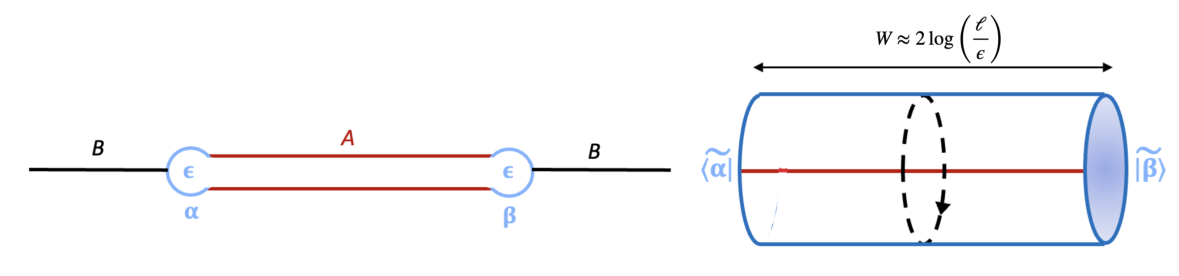
Small disks regulate the ends of the interval. A conformal map turns the replicated geometry into an annulus, where boundary states and defect insertions determine the charged moments. Cropped from Figure 1 of Das, Molina-Vilaplana and Saura-Bastida.
Scope. The derivation is for diagonal RCFTs with a unique bulk vacuum; parts of the analysis assume self-conjugate representations, and equal boundary conditions simplify the entropy formulas. Leading anyonic-sector asymptotics must be read with the vacuum-overlap assumptions in the paper.
Read abstract
A comprehensive symmetry resolution of the entanglement entropy (EE) in $(1+1)$-d rational conformal field theories (RCFT) with categorical non-invertible symmetries is presented. This amounts to symmetry resolving the entanglement with respect to the generalized twisted and anyonic charge sectors of the theory. The anyonic sectors label the irreducible representations of a modular fusion category defining the symmetry and can be understood through the $(2+1)$-d symmetry topological field theory (SymTFT) that encodes the symmetry features of the CFT. Using this, we define the corresponding generalized boundary dependent charged moments necessary for the symmetry resolution of the entanglement entropy, which is the main result of this work. Furthermore, contrary to the case of invertible symmetries, we observe the breakdown of entanglement equipartition between different charged sectors at the next-to-leading order in the ultraviolet cutoff.
Can thermal fluctuations make axial charge decay even when the applied magnetic field is zero? A one-loop calculation finds that the low-frequency response is too soft to generate a finite decay rate.
Treats the topological density, proportional to the scalar product of electric and magnetic fields, as a fluctuating operator rather than replacing both fields by their equilibrium values.
Computes its retarded two-point function at one loop using the electric and magnetic correlators of a magnetohydrodynamic plasma with zero background magnetic field.
Relates the low-frequency correlator to axial-charge relaxation through the memory-matrix formula, making it possible to test whether thermal fluctuations invalidate the classical slow-charge description.
Finds a leading nonanalytic contribution proportional to $|\Omega|^{3/2}$ in the frequency-dependent relaxation kernel. It tends to zero as the frequency vanishes, so this loop correction produces no finite axial decay rate at zero magnetic field.
Separates the integration into low- and high-frequency regions: the nonanalytic terms are fixed by infrared hydrodynamic data, while analytic terms also depend on the higher-frequency part of the calculation.
Explains why magnetic-flux conservation supplies extra constraints in the Abelian theory and identifies an all-loop symmetry argument and comparison with real-time lattice data as open directions.
From the paper
Fluctuations leave the zero-field decay rate unchanged
The leading small-frequency term is nonanalytic, but still vanishes. Thermal fluctuations therefore do not generate a finite zero-frequency axial relaxation rate at this order. This shows the leading behaviour of the full expansion, with its coefficient suppressed here.
Scope. Established at one loop in Abelian magnetohydrodynamic fluctuations, to leading order in the anomaly coupling. The work does not prove vanishing relaxation to all loop orders or extend that conclusion to non-Abelian plasmas.
Read abstract
Chiral magnetohydrodynamics is devoted to understanding the late-time and long-distance behavior of a system with an Adler-Bell-Jackiw anomaly at finite temperatures. The non-conservation of the axial charge is determined by the topological density $\vec{E} \cdot \vec{B}$; in a classical hydrodynamic description this decay rate can be suppressed by tuning the background magnetic field to zero. However it is in principle possible for thermal fluctuations of $\vec{E} \cdot \vec{B}$ to result in a non-conservation of the charge even at vanishing $B$-field; this would invalidate the classical hydrodynamic effective theory. We investigate this by computing the real-time susceptibility of the topological density at one-loop level in magnetohydrodynamic fluctuations, relating its low-frequency limit to the decay rate of the axial charge. We find that the frequency-dependence of this susceptibility is sufficiently soft as to leave the axial decay rate unaffected, validating the classical hydrodynamic description. We show that the susceptibility contains non-analytic frequency-dependence which is universally determined by hydrodynamic data. We comment briefly on possible connections to the recent formulation of the ABJ anomaly in terms of non-invertible symmetry.
Uses conformal boundary states to ask how non-invertible symmetries divide the entanglement of an interval.
Proposes categorical-symmetry-resolved entanglement: instead of sorting a reduced density matrix only by group charges, the construction uses projectors associated with non-invertible symmetry lines.
Makes the boundary conditions at the entanglement cut part of the construction. A symmetry line must be compatible with these boundaries for the corresponding charged moment to be defined in the chosen boundary-CFT setup.
Distinguishes strong and weak symmetry of boundary states and relates their availability to the gauging properties of the symmetry category.
Uses the critical Ising model to illustrate an obstruction: its simple Cardy boundary states do not preserve the full non-invertible Ising symmetry in the sense required by this construction.
Works out a positive example using the Fibonacci subcategory of the tricritical Ising model, constructing its two charge projectors and identifying compatible boundary states.
Finds a common leading logarithmic entropy for the Fibonacci sectors but different constant contributions governed by their quantum dimensions. This gives an explicit instance of subleading failure of entanglement equipartition.
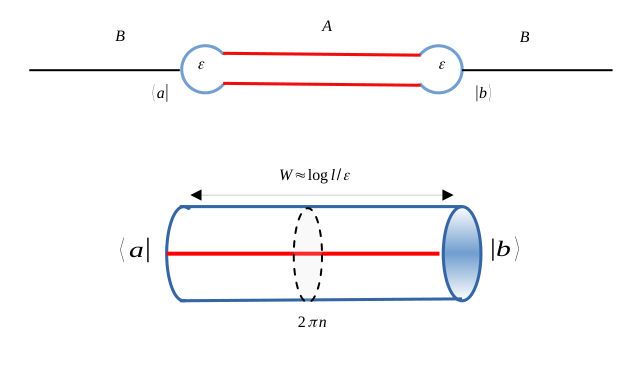
The boundary labels a and b do physical work: they determine which topological lines can end at the entangling points and therefore which symmetry resolution is available. Cropped from Figure 1 of Saura-Bastida, Das, Sierra and Molina-Vilaplana.
Scope. This is a boundary-state proposal with specific symmetry-compatibility and gauging assumptions. The Ising obstruction refers to this construction and its boundary choices, not to a proof that every possible definition of generalized symmetry resolution is impossible.
Read abstract
We propose a symmetry resolution of entanglement for categorical non-invertible symmetries (CaT-SREE) in (1 + 1)-dimensional CFTs. The definition parallels that of group-like invertible symmetries, employing the concept of symmetric boundary states with respect to a categorical symmetry. Our examination extends to rational CFTs, where the behavior of CaT-SREE mirrors that of group-like invertible symmetries. We find that CaT-SREE can be defined if there is no obstruction to gauging the categorical symmetry, as happens in the case of group-like symmetries. We also provide instances of the breakdown of entanglement equipartition at the next-to-leading order in the cutoff expansion. Our findings shed light on how the interplay between conformal boundary conditions and categorical symmetries lead to specific patterns in the entanglement entropy.
An MLDE and Rademacher-series argument gives a route to the established fact that a meromorphic CFT has central charge in multiples of eight.
Sets up the first-order modular differential equation for a single character at arbitrary Wronskian index ℓ, rather than assuming the allowed central charges at the outset.
Solves the equation in terms of the modular j-invariant and factors associated with the elliptic points and movable zeros. Odd ℓ solutions contain a square-root factor of j − 1728.
Uses the one-dimensional modular S and T relations to determine the sign of the S transformation. For odd ℓ, this sign is negative.
Combines that modular sign with Rademacher asymptotics to show that sufficiently high Fourier coefficients of an odd-ℓ solution are negative, ruling out its interpretation as a physical state-counting character.
Concludes that admissibility requires even ℓ; together with the one-character relation c = 4ℓ, this yields c = 8N.
Writes the surviving general character ansatz as a fractional power of j multiplied by a polynomial in j. The argument supplies a necessary constraint, not a classification or existence proof for every polynomial choice.
Odd Wronskian index gives a negative modular S sign, which makes the high-order Fourier coefficients negative in the Rademacher expansion. Requiring non-negative state degeneracies excludes that case.
Scope. This is a new route to an established constraint in the meromorphic, one-character setting, rather than a classification of all such CFTs.
Read abstract
In this short note, we present a simple and elementary proof that meromorphic conformal field theories (CFTs) have central charges of the form: $c=8N$ with $N\in\mathbb{N}$ (the set of natural numbers) using the modular linear differential equations (MLDEs) approach. We first set up the 1-character MLDE for arbitrary value of the Wronskian index: $\ell$. From this we get the general form of the meromorphic CFT's character. We then study its modular transformations and the asymptotic value of it's Fourier coefficients -- using Rademacher series -- to conclude that odd values of $\ell$ make the character in-admissible implying that the central charge for admissible character has to be a multiple of 8.
Real-time lattice simulations show that resistivity is the useful transport coefficient for a plasma with dynamical electromagnetism, and resolve an apparent disagreement in axial-charge relaxation.
Simulates classical electrodynamics coupled to charged matter at finite temperature and extracts transport coefficients from equilibrium correlation functions and controlled external probes.
Finds a finite resistivity from the electric-field Kubo formula. The same coefficient predicts the electric response to an imposed current and the diffusive relaxation of magnetic fields.
Shows that the usual current-current Kubo definition of the fully gauged conductivity vanishes at low frequency. Maxwell’s equations and electric-field relaxation explain why this differs from a conductivity defined before electromagnetism is made dynamical.
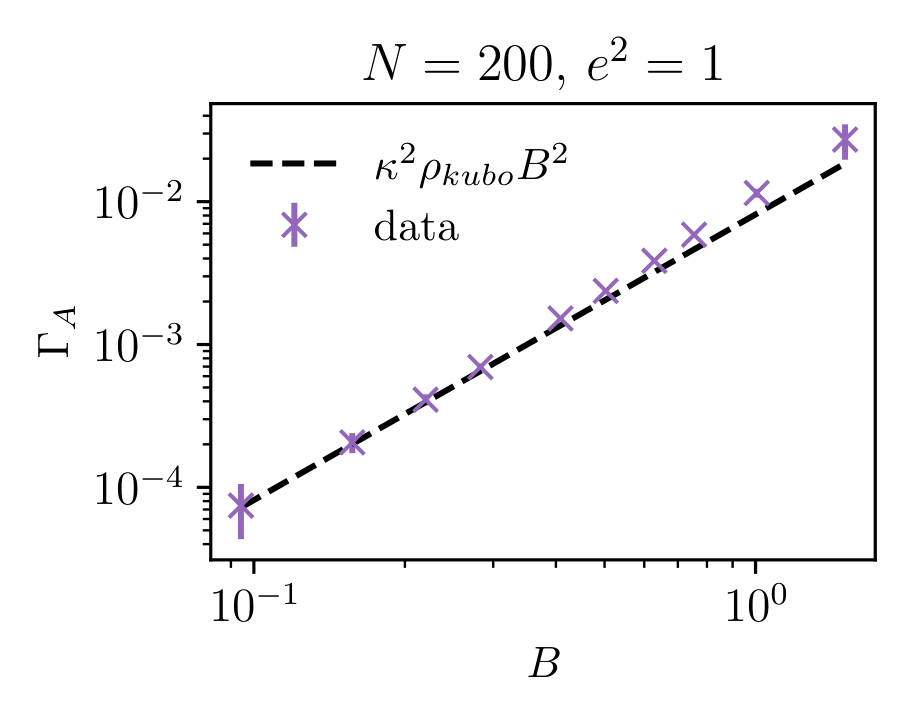
Tests the weak-field axial-relaxation relation $\Gamma_A=64\kappa^2 B^2\rho/\chi_A$ using independently measured resistivity, obtaining agreement with the lattice decay rate and resolving an earlier order-of-magnitude discrepancy.
Checks the same picture across electromagnetic couplings by comparing resistivity extracted from a Kubo formula, the response to an external current, and axial decay. The methods agree well, with small systematic differences at larger couplings.
Identifies the extra separation of time scales required to interpret an intermediate-frequency conductivity as the inverse resistivity, and observes departures from the quadratic magnetic-field law at stronger fields.
The lattice measurements follow the resistivity-based prediction at weak magnetic field; the stronger-field points begin to depart from the quadratic law. Reproduced from Figure 6 of Das, Florio, Iqbal and Poovuttikul.
Scope. Numerical evidence concerns the specified classical Abelian lattice plasma. The weak-field decay formula and the conditions for interpreting conductivity should not be extrapolated to arbitrary magnetic fields or non-Abelian theories.
Read abstract
We study classical lattice simulations of theories of electrodynamics coupled to charged matter at finite temperature, interpreting them using the higher-form symmetry formulation of magnetohydrodynamics (MHD). We compute transport coefficients using classical Kubo formulas on the lattice and show that the properties of the simulated plasma are in complete agreement with the predictions from effective field theories. In particular, the higher-form formulation allows us to understand from hydrodynamic considerations the relaxation rate of axial charge in the chiral plasma observed in previous simulations. A key point is that the resistivity of the plasma -- defined in terms of Kubo formulas for the electric field in the 1-form formulation of MHD -- remains a well-defined and predictive quantity at strong electromagnetic coupling. However, the Kubo formulas used to define the conventional conductivity vanish at low frequencies due to electrodynamic fluctuations, and thus the concept of the conductivity of a gauged electric current must be interpreted with care.
Movable poles make higher-index modular differential equations much less rigid. This paper makes their extra parameters explicit and relates them to the quasi-character construction.
Parametrises two-character MLDEs with any number r of generic movable poles, both in the torus variable τ and in the modular invariant j.
Derives accessory equations by demanding that the local solutions have no logarithms. These constraints reduce the 2r pole and accessory parameters to an r-dimensional space.
Sends a movable pole to infinity to relate the r-pole problem to the (r − 1)-pole problem. Iterating this relation determines the allowed exponents and central-charge ranges.
Solves the one-pole and two-pole cases in detail using Fourier expansions. The admissible families carry one free integer parameter for each movable pole.
Checks that the directly constructed MLDE solutions agree with the independent quasi-character approach, tying an algebraic construction of spectra to the geometry of differential-equation singularities.
Examines coincident-pole limits and gives examples realised by genuine CFTs. The paper keeps these realisations distinct from the much larger set of admissible character vectors.
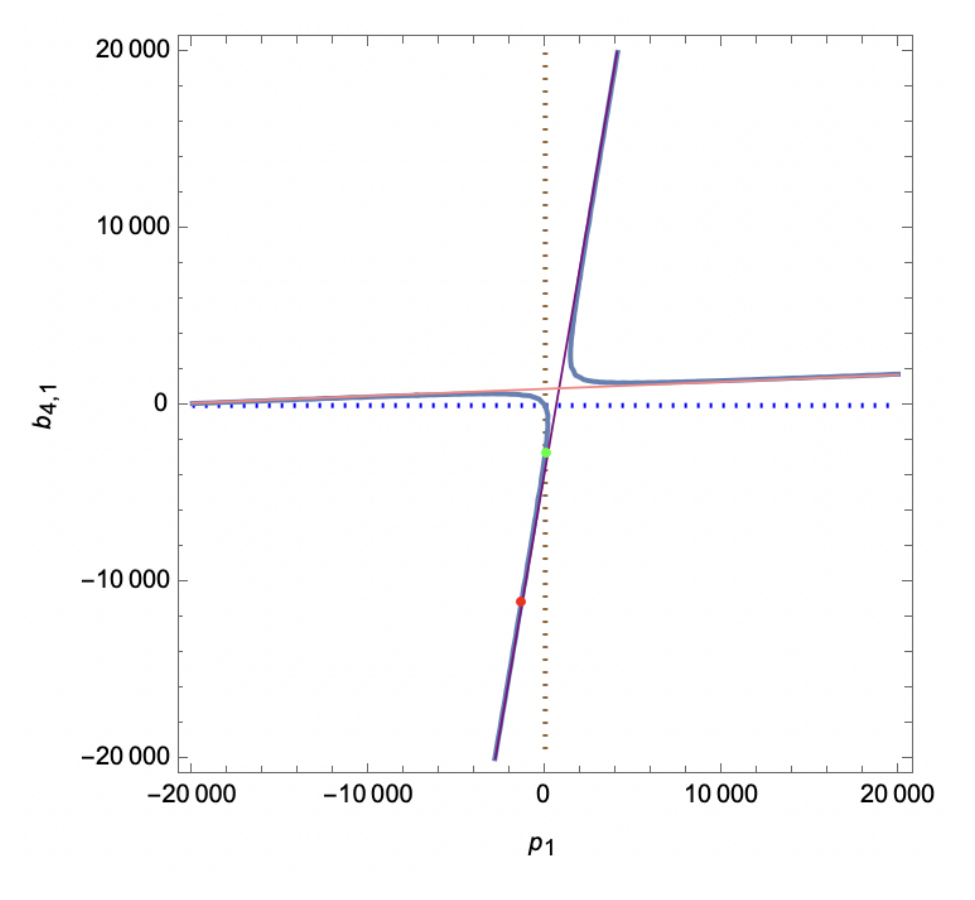
Figure 1 shows the c = 25, ℓ = 6 family as a curve in the pole-position/accessory-parameter plane. The two quantities cannot be chosen independently: the no-logarithm constraint ties them together. The paper parametrises the branches by the character-combination parameter N₁.
Scope. The general derivation assumes generic pole locations, with coincident poles discussed separately. The existence of infinitely many admissible character vectors does not imply infinitely many CFT realizations at fixed index.
Read abstract
Studies of modular linear differential equations (MLDE) for the classification of rational CFT characters have been limited to the case where the coefficient functions (in monic form) have no poles, or poles at special points of moduli space. Here we initiate an exploration of the vast territory of MLDEs with two characters and any number of poles at arbitrary points of moduli space. We show how to parametrise the most general equation precisely and count its parameters. Eliminating logarithmic singularities at all the poles provides constraint equations for the accessory parameters. By taking suitable limits, we find recursion relations between solutions for different numbers of poles. The cases of one and two movable poles are examined in detail and compared with predictions based on quasi-characters to find complete agreement. We also comment on the limit of coincident poles. Finally we show that there exist genuine CFT corresponding to many of the newly-studied cases. We emphasise that the modular data is an output, rather than an input, of our approach.
Builds effective descriptions of a chiral plasma directly from magnetic-flux conservation and the axial anomaly, connecting equilibrium currents, dissipative response and unusual long-wavelength modes.
Rewrites the Adler–Bell–Jackiw anomaly using the conserved two-form current that counts magnetic flux, so the starting point is the symmetry structure rather than a weakly coupled photon description.
Constructs an equilibrium Euclidean generating functional and a dissipative effective action, recovering aspects of the chiral separation and chiral magnetic effects within this framework.
Derives constitutive relations in which the anomaly-induced electric field is controlled by resistivity and an axial chemical-potential displacement from equilibrium.
Finds exponential relaxation of homogeneous axial fluctuations in a weak background magnetic field, with a rate proportional to resistivity times the squared field divided by axial susceptibility.
Studies coupled axial and magnetic perturbations: for the transverse momentum configuration considered, one long-wavelength mode is gapped while another is subdiffusive, beginning at $\omega\propto-iq^4$ instead of the usual $-iq^2$.
Describes non-invertible axial defect operators in both formulations and makes explicit the unresolved issues needed for a fully general theory, including the absence of the usual diagonal shift symmetry in the dissipative action.
From the paper
A subdiffusive long-wavelength mode
\[\omega_2(q)\propto-iq^4\qquad(q\to0)\]
For the transverse perturbations analysed in the paper, one coupled mode relaxes with a rate proportional to the fourth power of momentum. At shorter scales it returns to ordinary magnetic diffusion. The displayed expression isolates the scaling; Eq. (3.43) gives its coefficient.
Scope. A progress report toward a general effective action. The equilibrium functional is not exhaustive, thermal fluctuations are omitted, and the paper does not establish a universal all-orders relaxation formula or that subdiffusion uniquely diagnoses non-invertible symmetry.
Read abstract
We consider chiral magnetohydrodynamics, i.e. a finite-temperature system where an axial $U(1)$ current is not conserved due to an Adler-Bell-Jackiw anomaly saturated by the dynamical operator $F_{\mu\nu} \tilde{F}^{\mu\nu}$. We express this anomaly in terms of the 1-form symmetry associated with magnetic flux conservation and study its realization at finite temperature. We present Euclidean generating functional and dissipative action approaches to the dynamics and reproduce some aspects of chiral MHD phenomenology from an effective theory viewpoint, including the chiral separation and magnetic effects. We also discuss the construction of non-invertible axial symmetry defect operators in our formalism.
Admissible character series are only the starting point. Coset pairings provide further tests that separate spectra realised by CFTs from those that cannot describe one.
Pairs three-character solutions bilinearly with meromorphic characters at total central charges 8, 16, 24, 32 and 40, using the pairings as consistency tests and as guides to chiral-algebra realisations.
Starts from a list of 65 admissible character solutions and excludes 24 whose multiplicities fail the required integrality test.
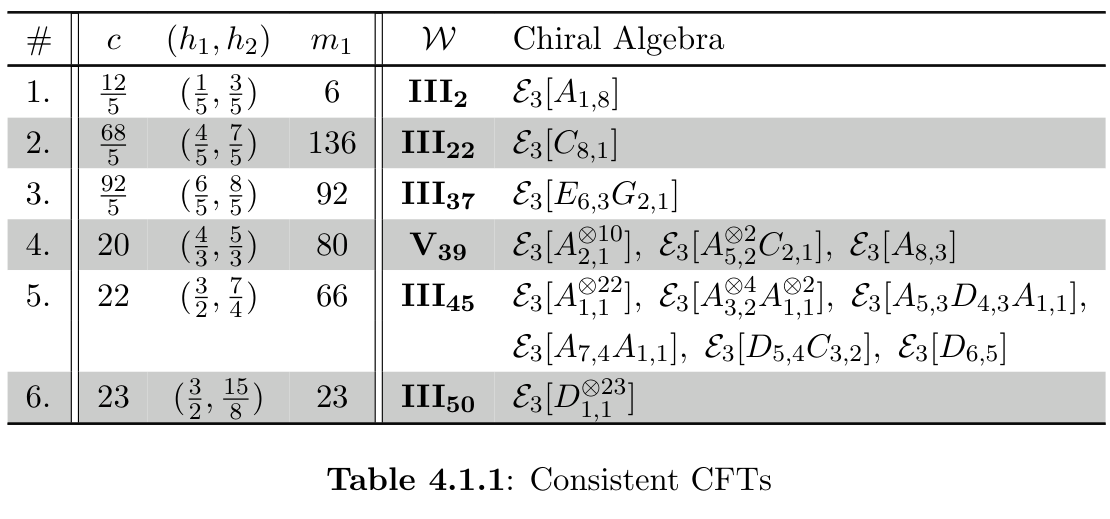
Organises the remaining 41 cases into six consistent character sets, 20 candidates of intermediate-vertex-operator-algebra type, and 15 character sets that cannot correspond to CFTs.
Identifies the chiral algebras of the consistent cases. Some character sets admit more than one CFT realisation, illustrating that character functions alone need not specify a unique theory.
Combines the result with known examples to give the unitary, three-character, ℓ = 0 list outside c = 8 and c = 16: two infinite affine series and 45 additional theories.
Uses inconsistent pairings to constrain proposed meromorphic theories as well, so the coset method produces both positive constructions and exclusion results.
Table 4.1.1 gives the six consistent character sets singled out in this part of the analysis. Several chiral algebras share the same character data. This is a subset of the final classification, whose full list combines these results with previously known theories.
Scope. The c = 8 and c = 16 sectors are excluded from the classification. The paper also explicitly notes representation-theoretic and embedding subtleties in turning all physics-level coset arguments into rigorous VOA statements.
Read abstract
We investigate the admissible vector-valued modular forms having three independent characters and vanishing Wronskian index and determine which ones correspond to genuine 2d conformal field theories. This is done by finding bilinear coset-type relations that pair them into meromorphic characters with central charges 8, 16, 24, 32 and 40. Such pairings allow us to identify some characters with definite CFTs and rule out others. As a key result we classify all unitary three-character CFT with vanishing Wronskian index, excluding $c=8,16$. The complete list has two infinite affine series $B_{r,1},D_{r,1}$ and 45 additional theories. As a by-product, at higher values of the total central charge we also find constraints on the existence or otherwise of meromorphic theories. We separately list several cases that potentially correspond to Intermediate Vertex Operator Algebras.
The MLDE method is extended beyond the full modular group to Fricke groups, bringing differential identities, character-like series and moonshine-related functions into one framework.
Builds a Ramanujan–Serre-type covariant derivative for prime-level Fricke groups and uses it to formulate modular differential equations for their character functions.
Derives Ramanujan–Eisenstein identities adapted to these groups. These relations express derivatives of modular forms in the same modular building blocks needed by the MLDEs.
Uses modular reparametrisation to simplify the equations, with detailed one-, two- and three-character analyses at Fricke levels two and three.
Finds admissible character-like series, including single-character examples linked to McKay–Thompson functions, while tracking when additional formal solutions have unstable coefficients.
Develops bilinear identities and candidate modular invariant partition functions, suggesting relations analogous to the familiar coset pairings for the full modular group.
Computes examples of Hecke relations among the single-character solutions and proposes further questions about their physical, lattice and representation-theoretic interpretations.
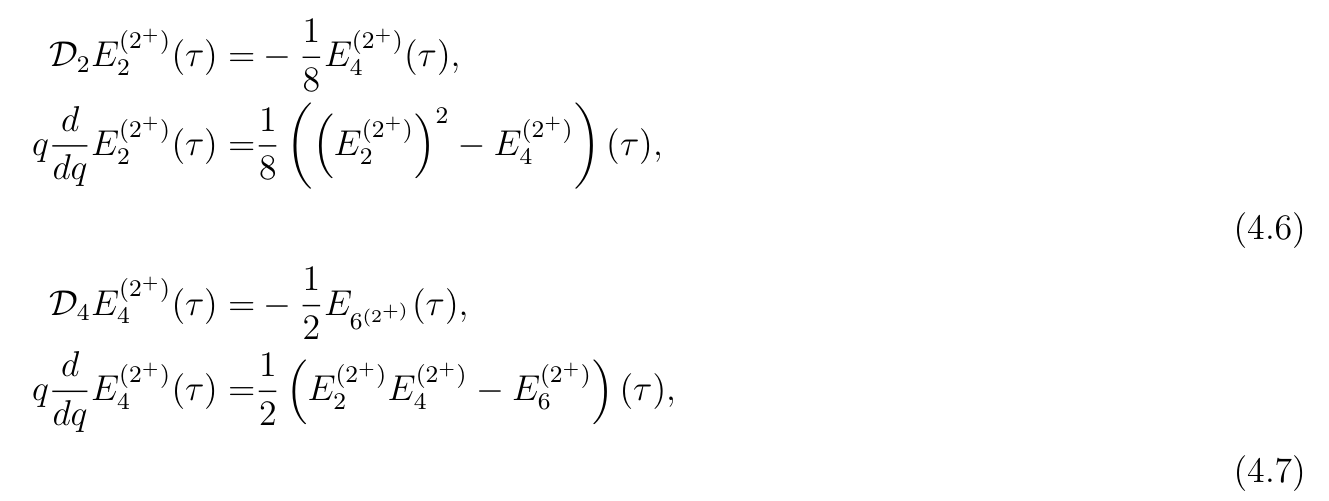
Equations (4.6) and (4.7), reproduced from the paper, show how differentiation closes on modular forms at Fricke level two. They provide the algebraic machinery for converting the MLDEs into a more tractable form.
Scope. The detailed solution analysis concentrates on Fricke levels two and three. Many resulting character-like functions and candidate partition functions are not established CFTs; the paper explicitly leaves their physical interpretation open.
Read abstract
In this work we extend the study of arXiv:2210.07186 by investigating two- and three-character MLDEs for Fricke groups at prime levels. We have constructed these higher-character MLDEs by using a $\mathit{novel}$ Serre-Ramanujan type derivative operator which maps $k$-forms to $(k+2)$-forms in $\Gamma^{+}_0(p)$. We found that this $\mathit{novel}$ derivative construction enabled us to write down a general prescription for obtaining $\mathit{Ramanujan-Eisenstein}$ identities for these groups. We discovered several $\mathit{novel}$ single-, two-, and three-character admissible solutions for Fricke groups at levels $2$ and $3$ after solving the MLDEs among which we have realized some in terms of Mckay-Thompson series and others in terms of modular forms of the corresponding Hecke groups. Among these solutions, we have identified interesting non-trivial bilinear identities. Furthermore, we could construct $\mathit{putative}$ partition functions for these theories based on these bilinear pairings, which could have a range of lattice interpretations. We also present and discuss modular re-parameterization of MLDE and their solutions for Fricke groups of prime levels.
Coset relations can be used in reverse: familiar lower-central-charge ingredients suggest new meromorphic theories at higher central charge.
Uses bilinear relations between three-character theories as evidence for meromorphic extensions, reversing the usual direction in which a known meromorphic theory supplies a coset.
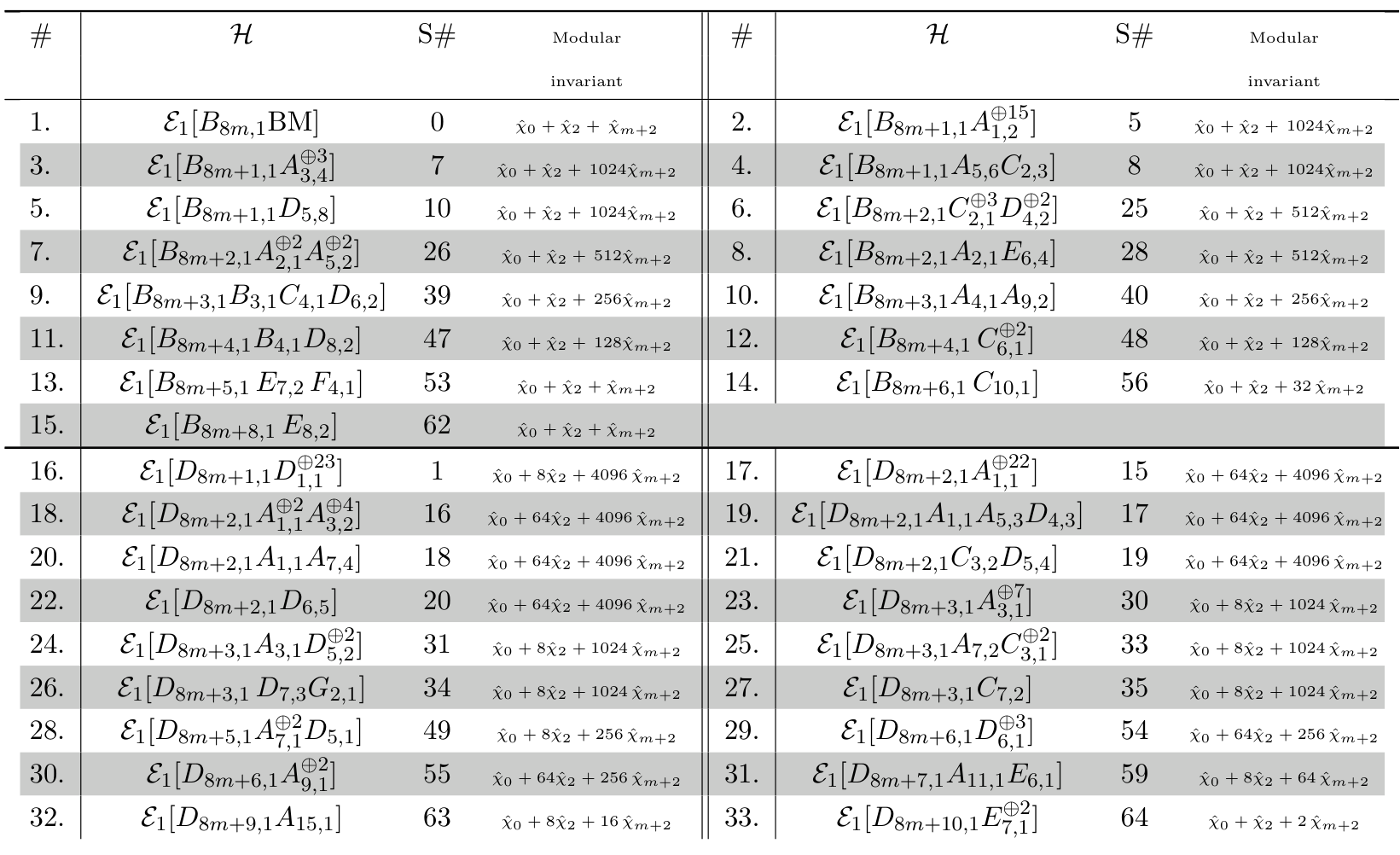
Proposes 34 infinite families at central charges c = 8m + 24. The m = 0 members connect to entries in the c = 24 Schellekens list.
Adds a finite collection of 46 proposed examples: seven at c = 32 and 39 at c = 40, with explicit character combinations and current-algebra information.
Explains why the construction can be repeated: the level-one B and D affine series retain three independent characters, while their modular transformation data recur periodically with rank.
Produces proposed non-lattice examples, including extensions with non-simply-laced current algebras or current-algebra levels greater than one.
Includes families involving the Baby Monster theory, showing that factors without a current algebra can participate alongside affine ingredients in the same meromorphic-extension framework.
Table 3 packages the proposed infinite families. Increasing m raises the central charge in steps of eight; the Schellekens column identifies the c = 24 seed. The symbols in the final columns specify the character bilinears used to build each proposed meromorphic extension. The crop shows rows 1–33; the final family continues on the following page.
Scope. These are proposals backed by detailed physics-level evidence; the paper does not claim a complete classification or a rigorous construction of every proposed VOA.
Read abstract
In recent years it has been understood that new rational CFTs can be discovered by applying the coset construction to meromorphic CFTs. Here we turn this approach around and show that the coset construction, together with the classification of meromorphic CFT with $c\leq 24$, can be used to predict the existence of new meromorphic CFTs with $c\geq 32$ whose Kac-Moody algebras are non-simply-laced and/or at levels greater than 1. This implies they are non-lattice theories. Using three-character coset relations, we propose 34 infinite series of meromorphic theories with arbitrarily large central charge, as well as 46 theories at $c=32$ and $c=40$.
Uses higher-form symmetry to construct a holographic model of a chiral plasma and follow how an axial charge imbalance decays in a background magnetic field.
Recasts the axial anomaly using the two-form current associated with conserved magnetic flux. This keeps the electromagnetic field dynamical and distinguishes the problem from an anomaly sourced only by a fixed external field.
Constructs a bulk holographic theory with the required symmetry structure through a dualisation procedure. The result gives a strongly interacting laboratory for anomalous magnetohydrodynamics without identifying the model with microscopic weakly coupled QED.
Computes the axial susceptibility as a function of temperature and background magnetic field, then locates the lowest relevant quasinormal mode to obtain the axial-charge relaxation rate.
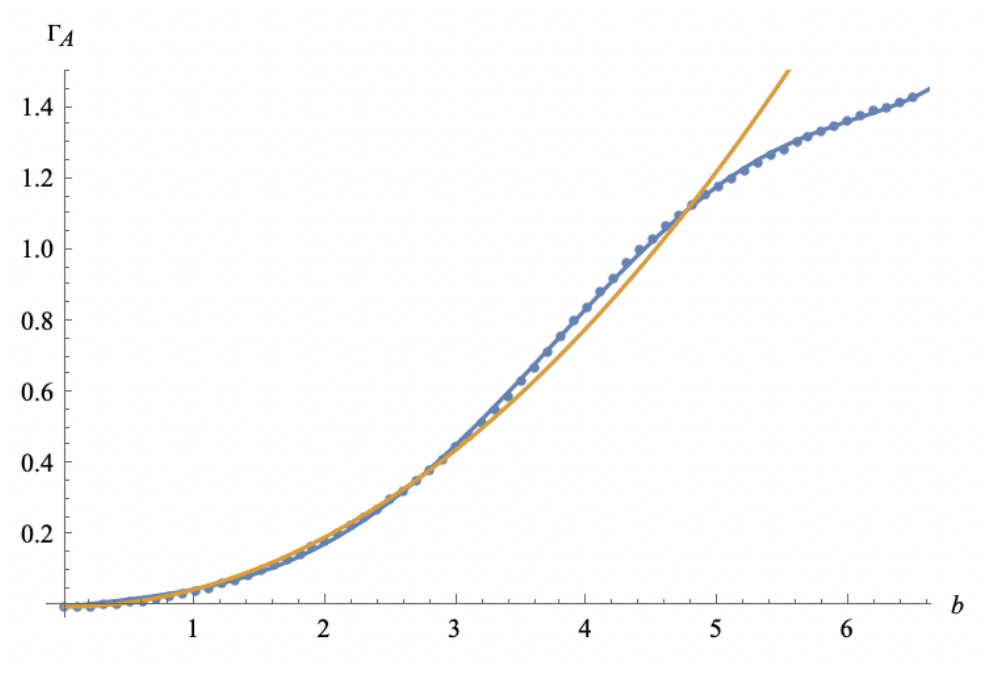
Derives the weak-field decay rate analytically using the hydrodynamic limit and the membrane paradigm. Its leading magnetic-field dependence is quadratic, and its coefficient agrees with the corresponding magnetohydrodynamic prediction.
Continues the calculation numerically to stronger fields and finds a clear departure from the elementary quadratic law. The full answer therefore contains information beyond a weak-field hydrodynamic approximation.
Compares the holographic result with the previously reported lattice discrepancy and identifies the electromagnetic transport coefficient as a quantity requiring careful comparison. This motivates later direct measurements of resistivity and axial relaxation.
The blue numerical result and orange quadratic fit agree at weak field, then separate as the magnetic field grows. The plotted parameters are k = 0.0375 and rₕ = 1. Cropped from the original paper.
Scope. The numerical strong-field curve is specific to the constructed holographic model. Agreement in symmetry structure and at weak fields does not make it a quantitative microscopic dual of the lattice theory.
Read abstract
In $U(1)$ Abelian gauge theory coupled to fermions, the non-conservation of the axial current due to the chiral anomaly is given by a dynamical operator $F_{\mu\nu} \tilde{F}^{\mu\nu}$ constructed from the field-strength tensor. We attempt to describe this physics in a universal manner by casting this operator in terms of the 2-form current for the 1-form symmetry associated with magnetic flux conservation. We construct a holographic dual with this symmetry breaking pattern and study some aspects of finite temperature anomalous magnetohydrodynamics. We explicitly calculate the charge susceptibility and the axial charge relaxation rate as a function of temperature and magnetic field and compare to recent lattice results. At small magnetic fields we find agreement with elementary hydrodynamics weakly coupled to an electrodynamic sector, but we find deviations at larger fields.
A finite arithmetic search turns third-order modular differential equations into an organised catalogue of candidate CFT spectra.
Studies three-character MLDEs at Wronskian indices ℓ = 0 and ℓ = 2 over the explicit range 0 < c ≤ 96.
Expresses MLDE parameters in terms of vacuum-character data and derives Diophantine constraints from the integrality of its Fourier coefficients, making the search finite.
Uses high-order Fourier checks to organise the ℓ = 0 solutions into five categories, separating known theories, unstable or otherwise non-physical solutions, and new admissible candidates.
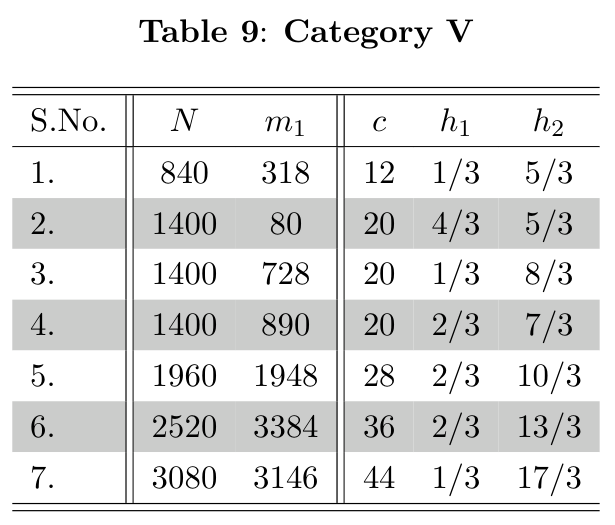
Finds seven then-new admissible spectra in Category V, with their central charges, conformal dimensions and low-level degeneracies tabulated for further consistency tests.
Shows that the admissible ℓ = 2 solutions in the search arise by adjoining a constant character to a two-character, ℓ = 0 solution.
Examines bilinear pairings with total central charge 24 to identify potential coset partners, helping connect the arithmetic output to possible CFT constructions.
Table 9 records the seven spectra that were new candidates at the time of this paper. The columns c and h₁,h₂ give central charge and conformal weights; m₁ counts the first excited vacuum level. Admissibility here is not an existence proof: the later coset-classification work tests their CFT realisation.
Scope. The stated search range is 0 < c ≤ 96. Candidate spectra are distinguished from proven CFTs, and the later coset-classification paper further tests their realization.
Read abstract
In the modular linear differential equation (MLDE) approach to classifying rational conformal field theories (RCFTs) both the MLDE and the RCFT are identified by a pair of non-negative integers $\textbf{[n,l]}$. $\mathbf{n}$ is the number of characters of the RCFT as well as the order of the MLDE that the characters solve and $\mathbf{l}$, the Wronskian index, is associated to the structure of the zeroes of the Wronskian of the characters. In this paper, we study $\textbf{[3,0]}$ and $\textbf{[3,2]}$ MLDEs in order to classify the corresponding CFTs. We reduce the problem to a "finite" problem: to classify CFTs with central charge $ 0 < c \leq 96$, we need to perform $6,720$ computations for the former and $20,160$ for the latter. Each computation involves (i) first finding a simultaneous solution to a pair of Diophantine equations and (ii) computing Fourier coefficients to a high order and checking for positivity. In the $\textbf{[3,0]}$ case, for $ 0 < c \leq 96$, we obtain many character-like solutions: two infinite classes and a discrete set of $303$. After accounting for various categories of known solutions, including Virasoro minimal models, WZW CFTs, Franc-Mason vertex operator algebras and Gaberdiel-Hampapura-Mukhi novel coset CFTs, we seem to have seven hitherto unknown character-like solutions which could potentially give new CFTs. We also classify $\textbf{[3,2]}$ CFTs for $ 0 < c \leq 96$: each CFT in this case is obtained by adjoining a constant character to a $\textbf{[2,0]}$ CFT, whose classification was achieved by Mathur-Mukhi-Sen three decades ago.
To search for new RCFTs using modular equations, it helps to know where familiar theories sit. This paper supplies a map in character-count/Wronskian-index space.
Computes the number n of independent characters and Wronskian index ℓ for broad families of WZW theories, Virasoro minimal models and N = 1 super-Virasoro theories.
Derives analytic formulae in tractable rank and level regimes and supplements them with systematic tables, relating representation-theoretic data to the labels of MLDEs.
Distinguishes independent characters from primary fields, a necessary step when different representations have identical character functions.
Shows that level-one WZW theories with at least two independent characters have ℓ = 0. The one-character E₈ level-one theory is an explicit exception, with ℓ = 2.
Collects known examples at small (n, ℓ), including two infinite affine series and additional discrete examples in the three-character, ℓ = 0 sector.
Provides benchmarks for later bootstrap searches: a candidate found by solving an MLDE can be compared against the catalogue to identify a known theory or a potentially new spectrum.
Excerpt from Table 5: the first three levels of the E₆, E₇ and E₈ series. Here k is the affine level, n the number of independent characters, c the central charge and ℓ the Wronskian index. The E₈ level-one entry makes the one-character exception visible.
Scope. This organizes known families and gives partial classifications; it does not classify every RCFT for a given character count and Wronskian index.
Read abstract
The classification scheme for rational conformal field theories, given by the Mathur-Mukhi-Sen (MMS) program, identifies a rational conformal field theory by two numbers: $(n, l)$. $n$ is the number of characters of the rational conformal field theory. The characters form linearly independent solutions to a modular linear differential equation (which is also labelled by $(n, l)$); the Wronskian index $l$ is a non-negative integer associated to the structure of zeroes of the Wronskian. In this paper, we compute the $(n, l)$ values for three classes of well-known CFTs viz. the WZW CFTs, the Virasoro minimal models and the $\mathcal{N} = 1$ super-Virasoro minimal models. For the latter two, we obtain exact formulae for the Wronskian indices. For WZW CFTs, we get exact formulae for small ranks (upto 2) and all levels and for all ranks and small levels (upto 2) and for the rest we compute using a computer program. We find that any WZW CFT at level 1 has a vanishing Wronskian index as does the $\mathbf{\hat{A}_1}$ CFT at all levels. We find intriguing coincidences such as: (i) for the same level CFTs with $\mathbf{\hat{A}_2}$ and $\mathbf{\hat{G}_2}$ have the same $(n,l)$ values, (ii) for the same level CFTs with $\mathbf{\hat{B}_r}$ and $\mathbf{\hat{D}_r}$ have the same $(n,l)$ values for all $r \geq 5$. Classifying all rational conformal field theories for a given $(n, l)$ is one of the aims of the MMS program. We can use our computations to provide partial classifications. For the famous $(2, 0)$ case, our partial classification turns out to be the full classification (achieved by MMS three decades ago). For the $(3, 0)$ case, our partial classification includes two infinite series of CFTs as well as seven ``discrete'' CFTs; except two all others have Kac-Moody symmetry.
Can a collapsing-shell radiation model retain quantum coherence when the exterior spacetime carries a global monopole? We extend the functional Schrödinger calculation beyond the asymptotically flat Schwarzschild setting.
Models a thin spherical shell with a global monopole exterior and a flat interior, coupled gravitationally to a quantized massless scalar field.
Derives the shell dynamics near horizon formation. The monopole changes the horizon radius and the exponential rate at which the shell approaches it in exterior time.
Reduces the scalar-field problem to a time-dependent harmonic oscillator, with the collapsing geometry determining the changing frequency.
Finds the evolving Gaussian wavefunction and its overlaps with the late-time oscillator basis; only even occupation numbers appear for the chosen initial vacuum.
Retains the off-diagonal density-matrix elements and checks analytically that the constructed final state is normalized and pure.
Gives a separate probability-current calculation in the incipient limit and recovers the corresponding Schwarzschild calculation when the monopole parameter vanishes.
A pure normalized state has unit purity. Here the full density matrix includes coherence between oscillator levels; keeping only occupation probabilities would discard those off-diagonal terms.
Key result from Eq. (73), with the density matrix and normalization in Eqs. (68)–(72).
Scope. The calculation concerns an idealized semiclassical shell and the near-formation limit. Purity refers to the state constructed in this model; full evaporation and a general resolution of black-hole information loss are not established.
Read abstract
Black hole radiation from an infinitesimally thin massive collapsing shell,
possessing a global monopole charge, which in turn leads to a Schwarzschild
black hole with a global monopole charge has been shown to be processed by a
unitary evolution. The exterior metric of the collapsing shell is described by
the global monopole (GM) metric. The analysis is performed using the
Wheeler-deWitt formalism which gave rise to a Schrödinger-like wave
equation. Existence of unitarity is confirmed from two independent lines of
approach. Firstly, by showing that the trace of the square of the density
matrix, of the outgoing radiation, from a quantized massless scalar field, is
unity. Secondly, by proving that the conservation of probability holds for the
wave function of the system.
How does electric charge affect a quantum description of radiation during collapse? We study a charged spherical shell with a Reissner–Nordström exterior and test the state’s normalization and purity analytically.
Builds a thin-shell model with a charged Reissner–Nordström exterior, a flat interior and a massless scalar field treated quantum mechanically.
Obtains the near-horizon shell trajectory and the redshift seen by an asymptotic observer, making the charge dependence explicit.
Recasts scalar-field evolution as a time-dependent oscillator and solves for its Gaussian state, then computes its amplitudes in a late-time particle basis.
Checks normalization and idempotency of the full density matrix, giving unit purity for the constructed final state while retaining off-diagonal correlations.
Presents a second, probability-current calculation in the incipient limit and connects the result to the uncharged Schwarzschild case.
Treats the extremal case separately: the shell’s distance from the horizon falls inversely with exterior time, rather than exponentially as in non-extremal collapse.
Here R± = M ± √(M² − Q²), and t is the exterior observer’s time. These leading near-horizon behaviours contrast ordinary charged collapse with the extremal limit. They describe the shell trajectory, not an evaporation rate.
Leading collapsing-branch behaviours restated from Eq. (26) on page 4 and Eqs. (72)–(73) on page 7.
Scope. These are semiclassical results for the near-formation limit of an idealized shell. They do not follow a black hole through complete evaporation or establish a general solution to the information paradox.
Read abstract
We have shown analytically that radiation from a collapsing shell which leads to a charged black hole, whose exterior is described by the RN (Reissner-Nordström) metric (and hence the background spacetime is non-globally hyperbolic), is processed with a unitary evolution. For the analysis, we have used the Wheeler-deWitt formalism which in turn gave rise to a Schrödinger-like wave equation. We showed the existence of unitarity by proving that the trace of the squared density matrix of the outgoing radiation, from a quantized massless scalar field, is unity and that the conservation of probability holds for the wave function of the system.
No matching papers.
Try a different title, author, year or research area.
Bibliographic metadata checked against INSPIRE on 5 November 2026; acceptance information updated from my November 2026 CV. Years refer to first posting; journal publication dates may differ. Theses are listed on the About page.
 Enlarge image ↗